South Pacific Metals Corp. Drills 92 m of Mineralisation at Ontenu NE; Peak Intercepts Return 9.92 g/t Gold and 2.35% Copper
Mineralisation hit in 5 of 7 holes; high-grade intercepts at Onki (9.92 g/t Au, 2.35% Cu) and Jorkol (3.16 g/t Au with 602 ppm Bi) confirm SPMC is drilling within a mineralised hydrothermal system — ongoing drilling will target the productive, high-grade parts of the veins.
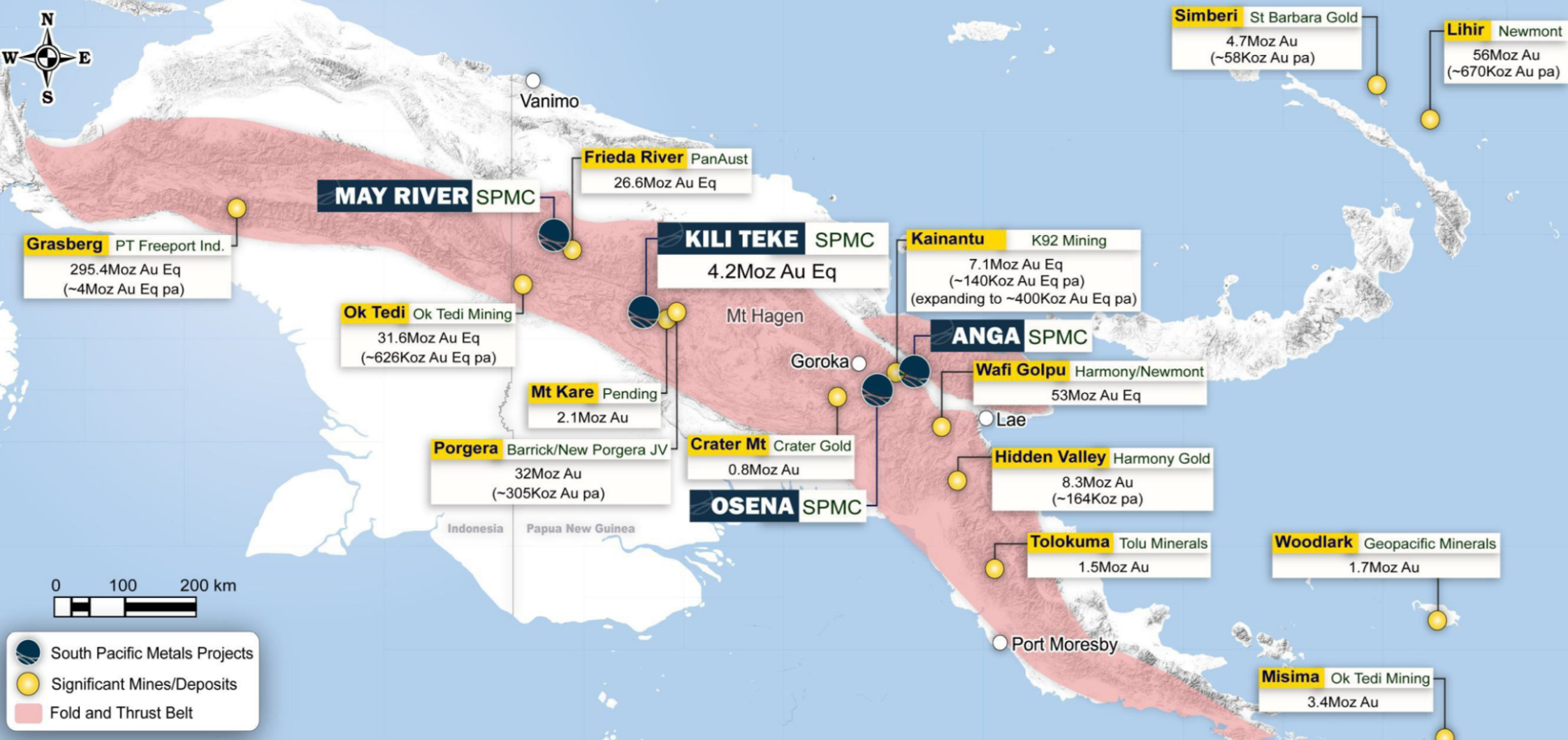
Vancouver, British Columbia – May 20, 2026 – South Pacific Metals Corp. (TSX-V: SPMC | FSE: 6J00 | OTCQB: SPMEF) (“SPMC” or the “Company”) reports results from the first-ever drill program at its Ontenu NE project in Papua New Guinea — seven holes for 2,266 m completed to date within the wider Osena Project area on the Kainantu Transfer Zone, the same regional structural corridor that hosts K92 Mining’s producing Kainantu gold-copper mine (see Figure 6). Assays have been received for six holes; the seventh is pending. Holes 8 and 9 are currently being drilled.
Program Highlights
-
- Gold mineralisation confirmed in 5 of 7 holes across two distinct zones (Onki and Jorkol) and two distinct mineralisation styles (see Figure 4).
-
- Two high-grade peak intercepts on the K92 corridor:
-
- Onki Zone — hole ONED26-006: 2 m @ 5.74 g/t Au, 1.49% Cu, 35 g/t Ag (peak 9.92 g/t Au re-assay, 2.35% Cu).
-
- Jorkol Zone — hole ONED25-001: 0.5 m peak assaying 3.16 g/t Au, 0.62% Cu, 96 g/t Ag with 602 ppm Bi.
-
- Two high-grade peak intercepts on the K92 corridor:
-
- Wide low-grade halos surrounding both peaks — 92 m @ 0.34 g/t Au at Onki and 4.5 m @ 0.77 g/t Au at Jorkol — with multi-element pathfinder signatures (As, Sb, Bi, Te) characteristic of intermediate- to high-sulfidation epithermal systems.
-
- Geological evidence of an intact, vertically zoned hydrothermal system at Onki: phreatic breccia overlying an intensely silicified horizon, interpreted as a silica cap above a preserved hydrothermal system.
-
- Large volumes of hydrothermal fluids have interacted with host rocks to cause significant alteration and broad intervals of mineralisation, with higher-grade intercepts over narrower widths.
-
- Strongest bismuth signature of the program (602 ppm Bi) in the Jorkol 0.5 m peak sample — elevated Bi-Te with Au is a diagnostic indicator of intrusion-related gold-vein mineralisation, the same model that underpins K92’s Kora and Judd vein systems.
-
- Ontenu Central advancing in parallel: a 2 km zoned alteration footprint with classic porphyry signature mapped (Figure 6), with a relatively shallow (~400 m) porphyry target defined beneath surface Au-Cu (Te-Bi-As) anomalies.
-
- Most NW-trending structures yet to be drill-tested, including two cutting the Onki Zone, several with artisanal workings.
-
- Octavio Garcia appointed Exploration Manager: 30 years of international experience in porphyry, epithermal, IOCG and orogenic systems with Mt Isa Mines, Barrick and Xstrata, including direct PNG experience.
CEO, Timo Jauristo, commented “This maiden drill program has achieved many milestones. We targeted and have been drilling Ontenu NE to confirm our concept that we have signatures of Kora-Judd style mineralisation on our ground – and the answer is yes. We have intersected mineralisation in 5 of 7 holes; hit two high-grade Au-Cu intercepts within wider lower-grade halos; are developing a better understanding of the geology, structure and mineralisation in the area; and are compiling a geological model that will help guide future drilling towards more productive parts of the veins.
This work is helping us vector into higher grade parts of the epithermal system. Mineralisation, alteration, pathfinder geochemistry, and the structures in core and at surface indicate that the productive parts of both systems remain to be found, either along strike or at deeper levels.
Multiple exciting targets are developing at Ontenu Central – large surface Cu-Au soil and trench anomalies, NW trending structures, and a large, relatively shallow porphyry beneath both zones. Drilling is ongoing at Ontenu NE and will soon commence at Ontenu Central. With Octavio Garcia now in the seat as Exploration Manager, our understanding of these mineral systems will accelerate.
We are all excited with how these projects are advancing and eagerly await results from ongoing mapping and drilling.”
What We Will Do Next
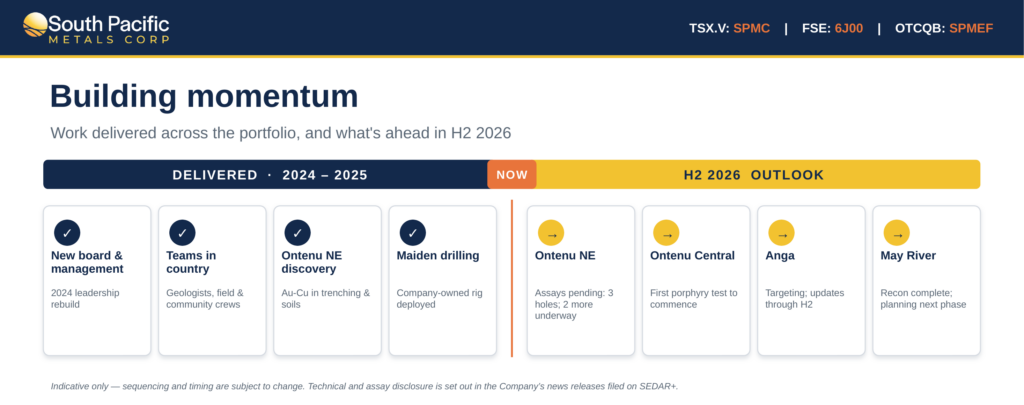
Drilling continues at Ontenu NE, with the next holes designed to test the two newly identified NW-trending structures at Onki, drill deeper beneath the Onki silica cap, and step out along strike and at depth at Jorkol. At Ontenu Central, the Company expects to mobilise drilling shortly following completion of detailed mapping. Surface exploration continues at Anga, immediately northeast of K92.
Appointment of Exploration Manager
The Company welcomes Octavio Garcia as Exploration Manager. Mr. Garcia is responsible for geological and exploration supervision across the Company’s projects. He is a graduate of the National University of San Juan, Argentina, and has 30 years of mineral exploration experience worldwide, including in Papua New Guinea, with prior roles at Mt Isa Mines, Barrick and Xstrata. His experience spans the circum-Pacific region — from the Andes of South and Central America through the arc and back-arc terranes of north-eastern Australia and Papua New Guinea — and covers porphyry, epithermal, IOCG and orogenic deposit styles.
Onki Zone — Technical Detail
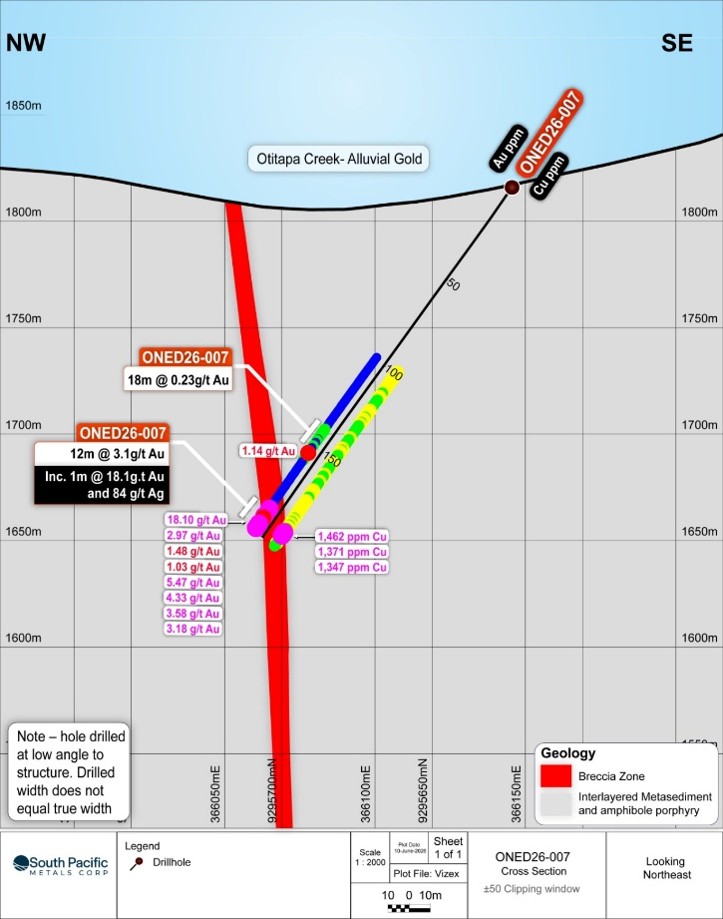
The Onki Zone is a 2025 discovery made by the Company. Testing Au-Cu mineralisation on NNE- to N-trending structures, three holes have been drilled at Onki for a total of 1,055 m: ONED26-002, ONED26-003 and ONED26-006. Assays have been received for ONED26-002 and ONED26-003 in full and partially for ONED26-006.
Key intercepts:
-
- 92 m @ 0.34 g/t Au from 67 m in ONED26-006, including 2 m @ 5.74 g/t Au, 1.49% Cu, 35 g/t Ag from 119 m (peak assay 9.92 g/t Au) — see Figure 1.
-
- 99 m @ 0.23 g/t Au from 1 m in ONED26-002, including 11 m @ 0.22% Cu, 0.18 g/t Au, 1.1 g/t Ag from 42 m — see Figure 2.
-
- 20.7 m @ 0.21 g/t Au, 0.1% Cu, 2.9 g/t Ag from 42.3 m in ONED26-003.
ONED26-006 was drilled beneath a coincident Au-Cu-Mo soil anomaly (Figure 1). Wide zones of phreatic breccia overlying an intense silicification horizon are consistent with a silica-cap setting above a preserved hydrothermal system, implying the productive parts of the system most likely sit at depth, intact and untested. Copper assays reported here use a 3-acid digest method; pulps have been sent to Intertek Perth for full 4-acid ICP-MS analysis, and molybdenite has been logged in core with assays pending.
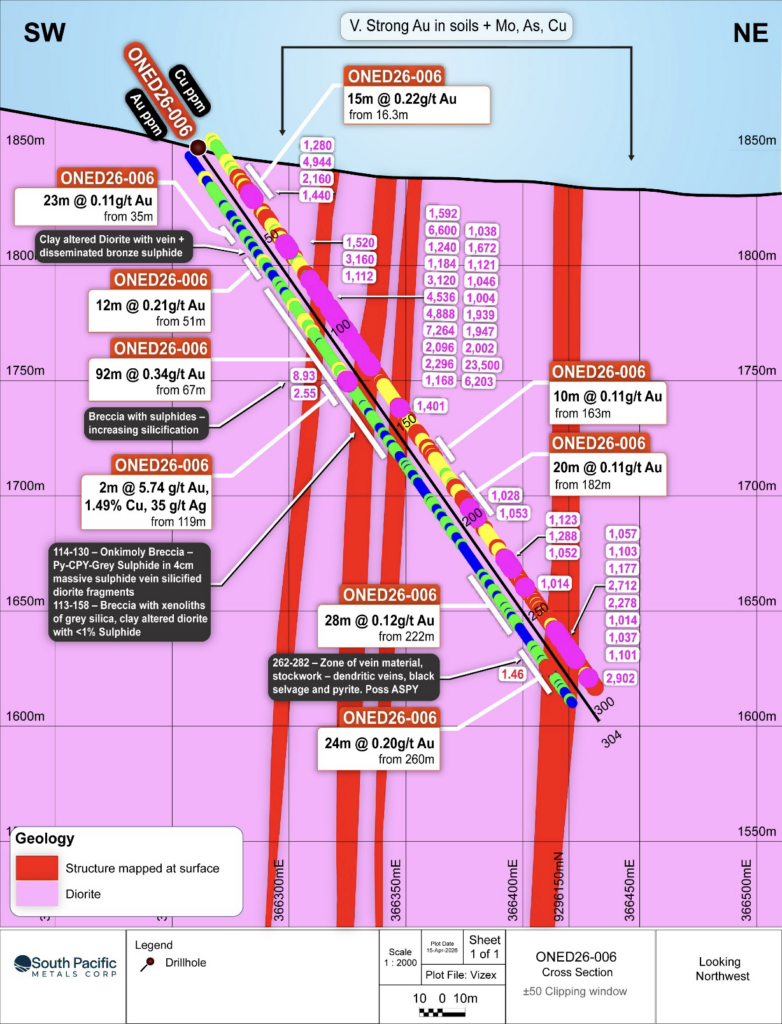
Figure 1. ONED26-006 cross-section (SW–NE) at the Onki Zone, showing the silica cap / phreatic breccia interpretation overlying the 92 m @ 0.34 g/t Au intercept and the 2 m @ 5.74 g/t Au (peak 9.92 g/t Au) breccia at 119 m.
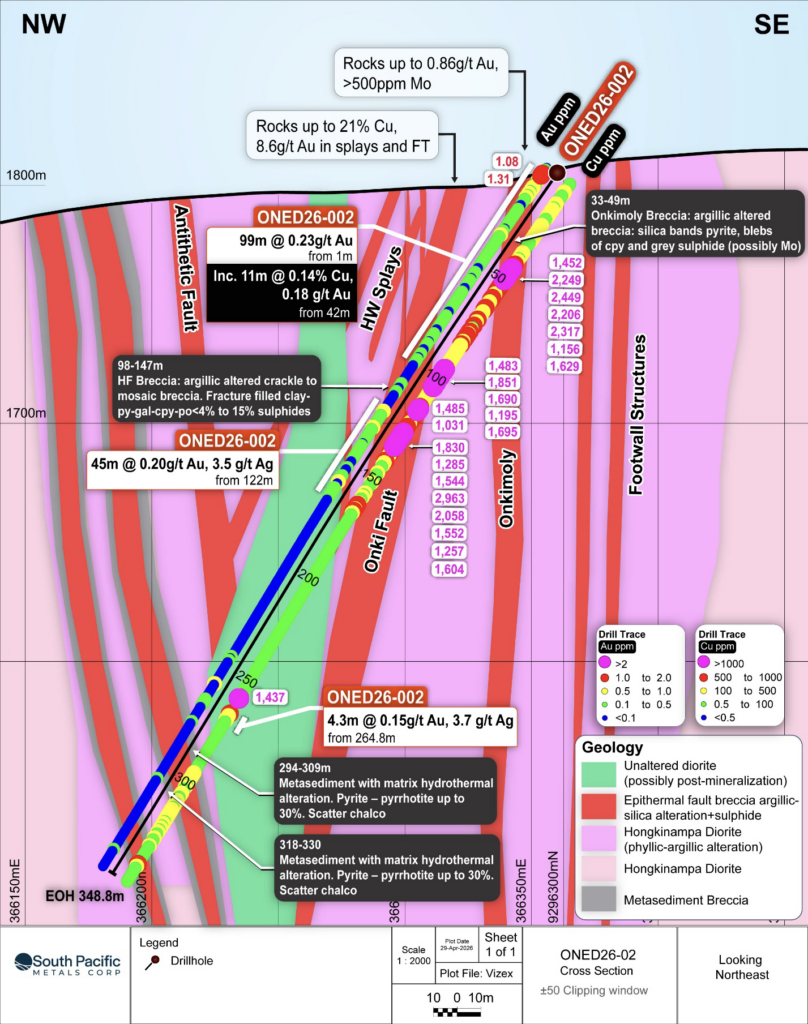
Figure 2. ONED26-002 cross-section (NW–SE) at the Onki Zone, showing the 99 m @ 0.23 g/t Au intercept from surface and the Onki Fault structural context with footwall structures yet to be tested.
Jorkol Zone — Technical Detail
The Jorkol Zone is one of several NW-trending mineralised structures (Jorkol structure, Agau structure and other un-named zones) identified by the Company in 2025, mapped at surface over several hundred metres with regional geochemistry suggesting potential strike extensions beyond 1 km. The structural setting — NW-SE structures hosted in metasediments with associated intrusive dykes — is comparable to the Kora-Judd vein systems being mined by K92 Mining.
Key intercepts:
-
- 4.5 m @ 0.77 g/t Au, 0.14% Cu, 19 g/t Ag from 203.5 m in ONED25-001, including a 0.5 m peak sample assaying 3.16 g/t Au, 0.62% Cu, 96 g/t Ag with 602 ppm Bi (see Figure 3).
-
- 15 m @ 0.19 g/t Au, 2.4 g/t Ag from 215 m in ONED25-001
-
- 5.5 m @ 0.36 g/t Au, 7.6 g/t Ag from 117.5 m in ONED25-001
-
- 8 m @ 0.74 g/t Au, 8.5 g/t Ag from 51 m in ONED26-004.
-
- 3 m @ 1.03 g/t Au, 68 g/t Ag from 43 m in ONED26-004.
The 0.5 m peak sample in ONED25-001 carries the strongest bismuth signature in the entire program (602 ppm Bi). Elevated Bi-Te in the presence of Au is a diagnostic indicator of intrusion-related gold-vein mineralisation — the same geological model that underpins K92’s Kora and Judd vein systems. The drill core, multi-element geochemistry and alteration logging together indicate that the drilling to date has tested the upper or distal levels of an intermediate- to high-sulfidation epithermal system, with several narrow vein structures intersected (Figure 3). The next phase of drilling is directed at deeper levels and along-strike extensions of Jorkol and the other NW-trending structures, where the system is expected to be more productive.
Figure 3. ONED25-001 cross-section (SW–NE) at the Jorkol Zone, showing the hole intersecting the Jorkol and Agau vein structures, with the 4.5 m @ 0.77 g/t Au intercept (peak 3.16 g/t Au, 0.62% Cu, 96 g/t Ag over 0.5 m) at 203.5 m and the 5.5 m @ 0.36 g/t Au intercept at 117.5 m. Multiple narrow vein structures untested at depth.
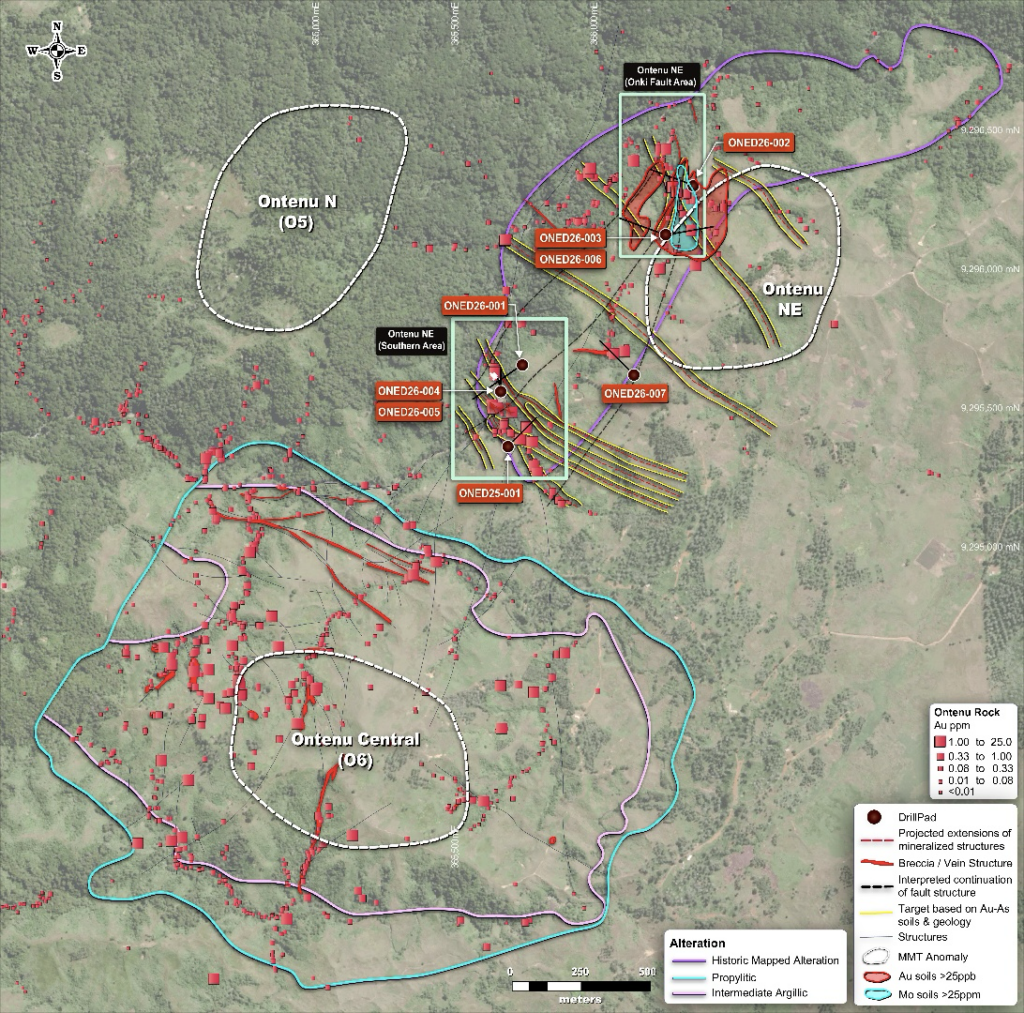
Figure 4. Ontenu NE drill area showing the Onki Zone (north) and the Jorkol Zone (south), with mapped alteration zones (propylitic, intermediate argillic, historic), interpreted continuation of fault structures, and Au-As soil and rock-chip anomalies. Drill holes ONED25-001 and ONED26-001 through ONED26-007 shown.
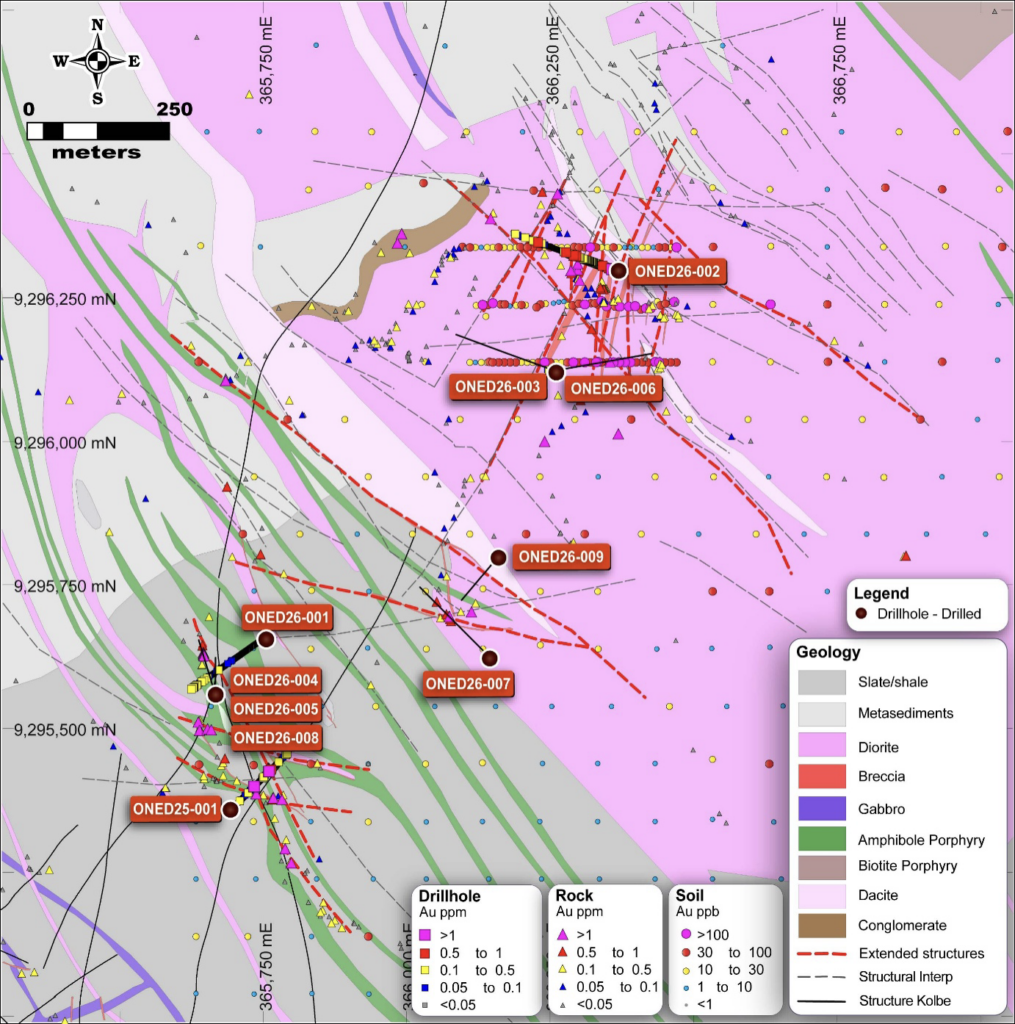
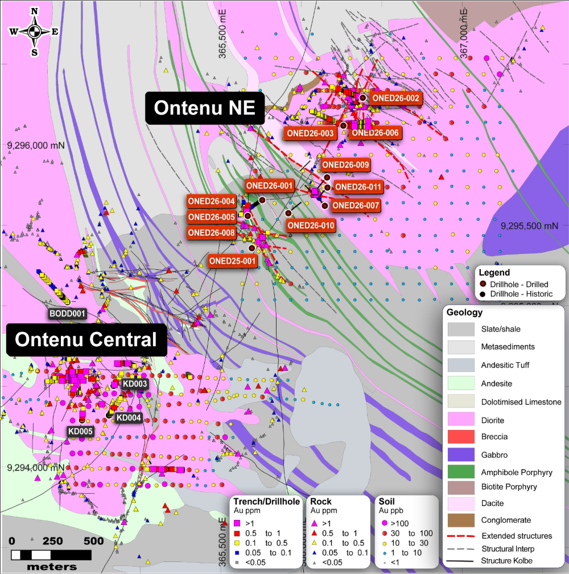
Figure 5. Detailed geology map of Ontenu NE drill area showing bedrock geology, all drill collars (ONED25-001 through ONED26-009), interpreted and extended mineralised structures, and Au-in-rock and Au-in-soil geochemistry. Two new NW-trending structures cutting the Onki Zone are shown but remain untested by drilling.
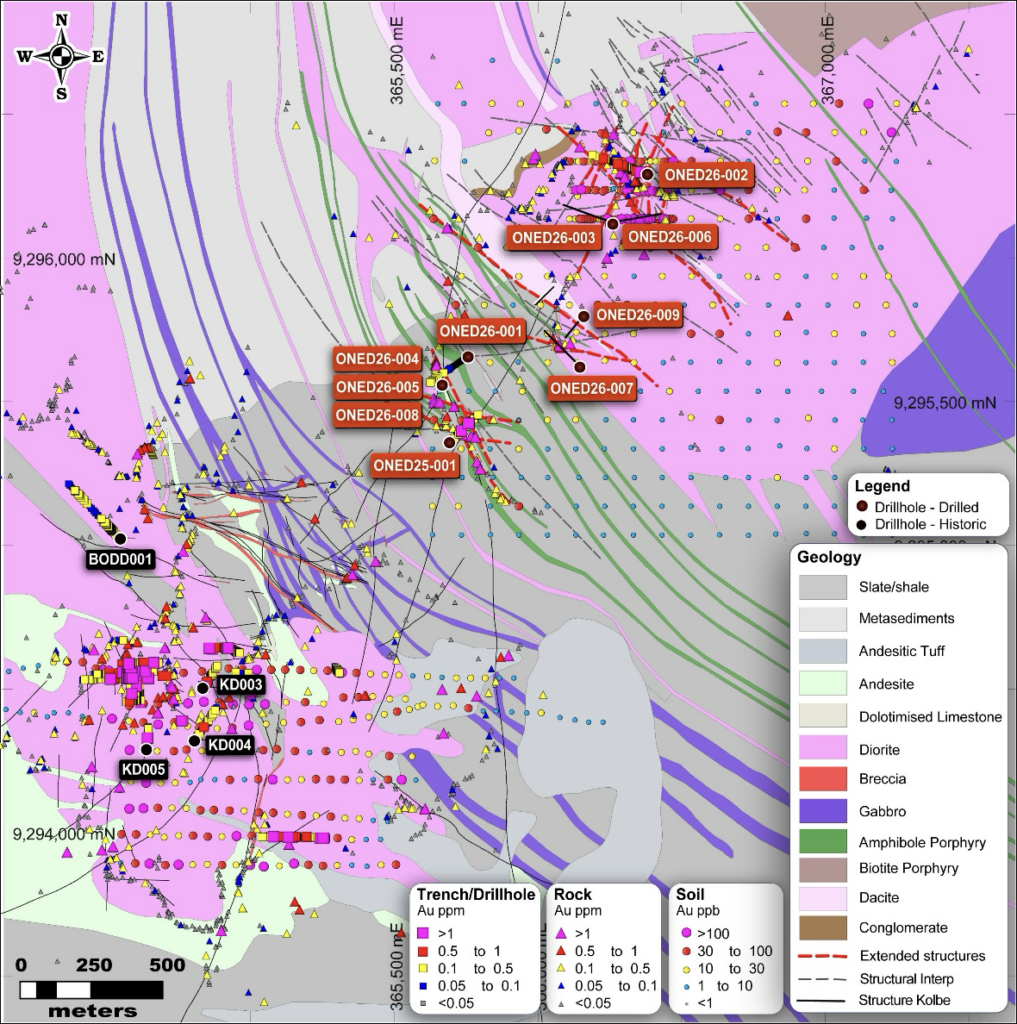
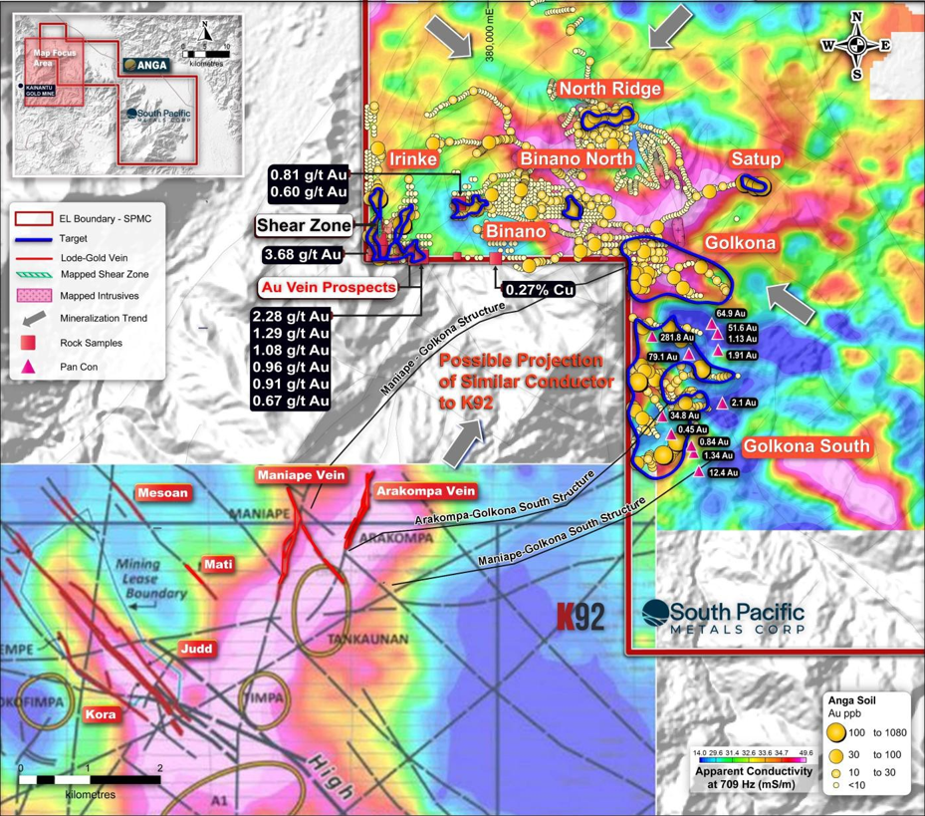
Figure 6. Wider Ontenu Project area geology and geochemistry, showing Ontenu NE (north) and Ontenu Central (south) target areas, regional structural setting, and the position of the projects within the Kainantu Transfer Zone on the same regional corridor as K92 Mining’s operations to the north.
Summary Drill Results — Ontenu NE
Table 1. Composite drill intersections — 0.1 g/t Au cut-off, minimum 3 m internal dilution
| Hole ID | Zone | From (m) | To (m) | Interval (m) | Au (g/t) | Cu (ppm) | Ag (g/t) |
| ONED26-006 | Onki | 67 | 159 | 92 | 0.34 | 1,226 | 2.3 |
| ONED26-002 | Onki | 1 | 100 | 99 | 0.23 | 566 | 1.0 |
| ONED26-002 | Onki | 122 | 167 | 45 | 0.20 | 516 | 4.4 |
| ONED26-004 | Jorkol | 51 | 59 | 8 | 0.74 | 104 | 8.5 |
| ONED26-006 | Onki | 260 | 284 | 24 | 0.20 | 894 | 1.6 |
| ONED26-003 | Onki | 42.3 | 63 | 20.7 | 0.21 | 1,000 | 2.9 |
| ONED25-001 | Jorkol | 203.5 | 208 | 4.5 | 0.77 | 1,368 | 19.0 |
| ONED26-006 | Onki | 222 | 250 | 28 | 0.12 | 678 | 1.1 |
| ONED26-006 | Onki | 16.3 | 31.3 | 15 | 0.22 | 875 | 3.6 |
| ONED26-004 | Jorkol | 43 | 46 | 3 | 1.03 | 120 | 68.0 |
| ONED26-005 | Jorkol | 114 | 123 | 9 | 0.34 | 1,808 | 15.7 |
| ONED25-001 | Jorkol | 215 | 230 | 15 | 0.19 | 188 | 2.4 |
| ONED26-006 | Onki | 51 | 63 | 12 | 0.21 | 844 | 1.3 |
| ONED26-006 | Onki | 35 | 47 | 23 | 0.11 | 479 | 1.4 |
| ONED26-003 | Onki | 261.6 | 279 | 17.4 | 0.13 | 632 | 0.9 |
| ONED26-006 | Onki | 182 | 202 | 20 | 0.11 | 527 | 0.9 |
| ONED25-001 | Jorkol | 117.5 | 123 | 5.5 | 0.36 | 145 | 7.6 |
| ONED26-005 | Jorkol | 73 | 80 | 7 | 0.20 | 114 | 5.7 |
| ONED26-006 | Onki | 163 | 173 | 10 | 0.11 | 445 | 0.5 |
Table 2. High-grade intercepts — 1 g/t Au cut-off, minimum 0.5 m (results received to date)
| Hole ID | Zone | From (m) | To (m) | Interval (m) | Au (g/t) | Cu (ppm) | Ag (g/t) | Notes |
| ONED25-001 | Jorkol | 117.5 | 118 | 0.5 | 1.04 | 215 | 7.0 | |
| ONED25-001 | Jorkol | 119.7 | 120 | 0.3 | 1.08 | 370 | 22.0 | |
| ONED25-001 | Jorkol | 204.5 | 207.5 | 3 | 1.04 | 2,028 | 26.4 | |
| ONED25-001 | Jorkol | ~204 | ~205 | 0.5 | 3.16 | 6,198 | 96.0 | Max 0.5 m within the 4.5 m / 0.77 g/t composite; Bi 602 ppm (strongest IRGS signature in program) |
| ONED26-002 | Onki | 3 | 5 | 2 | 1.20 | 155 | 0.8 | |
| ONED26-004 | Jorkol | 43 | 44 | 1 | 2.60 | 122 | 194.0 | |
| ONED26-004 | Jorkol | 51 | 52 | 1 | 2.79 | 139 | 5.0 | |
| ONED26-006 | Onki | 119 | 121 | 2 | 5.74 | 14,852 | 35.0 | Peak 1m assay: 8.93 g/t Au; re-assayed at 9.92 g/t Au. Peak Cu assay 2.35% |
| ONED26-006 | Onki | 271 | 272 | 1 | 1.46 | 2,278 | 12.0 |
Table 3. Copper intercepts — 1,000 ppm Cu cut-off, minimum 3 m internal dilution
| Hole ID | Zone | From (m) | To (m) | Interval (m) | Cu (ppm) | Au (g/t) | Ag (g/t) |
| ONED26-002 | Onki | 42 | 53 | 11 | 2,246 | 0.18 | 1.1 |
| ONED26-003 | Onki | 216 | 232 | 16 | 1,145 | 0.09 | 0.8 |
| ONED26-005 | Jorkol | 114 | 118 | 4 | 3,313 | 0.45 | 29.3 |
| ONED26-002 | Onki | 126 | 134 | 8 | 1,589 | 0.26 | 4.1 |
| ONED26-003 | Onki | 52 | 61 | 9 | 1,200 | 0.25 | 3.4 |
| ONED26-006 | Onki | 117 | 121 | 4 | 8,068 | 3.13 | 18.5 |
| ONED26-003 | Onki | 139 | 148 | 9 | 1,155 | 0.10 | 0.6 |
Table 4. Drill collar details — all coordinates WGS84 Zone 55
| Hole ID | Target | Easting | Northing | Elev (m) | Length (m) | Azimuth | Dip | Assay Status |
| ONED25-001 | Jorkol | 365,693 | 9,295,361 | 1,771 | 318.8 | 45 | -61 | Received Au+Full ME |
| ONED26-001 | Jorkol | 365,745 | 9,295,652 | 1,762 | 400.0 | 235 | -57 | Received Au+Full ME |
| ONED26-002 | Onki | 366,382 | 9,296,303 | 1,817 | 348.8 | 290 | -55 | Received Au+Full ME |
| ONED26-003 | Onki | 366,254 | 9,296,133 | 1,823 | 401.9 | 290 | -55 | Received preliminary Au-Cu-Ag |
| ONED26-004 | Jorkol | 365,667 | 9,295,561 | 1,769 | 171.1 | 347 | -55 | Received preliminary Au-Cu-Ag |
| ONED26-005 | Jorkol | 365,667 | 9,295,561 | 1,769 | 123.0 | 0 | -55 | Received preliminary Au-Cu-Ag |
| ONED26-006 | Onki | 366,261 | 9,296,122 | 1,851 | 304.0 | 93 | -55 | Received preliminary Au-Cu-Ag Partial / Pending |
| ONED26-007 | Megabe | 366,147 | 9,295,620 | 1,824 | 198.8 | 325 | -55 | Pending |
Quality Assurance and Quality Control
All drill holes are logged on site by the Company’s geology team. Drill core (PQ or HQ) is half-cut, with samples secured and shipped to Intertek Laboratory in Lae, Papua New Guinea. Gold is assayed by 50 g fire assay with AAS finish (FA50/AA); copper and silver are assayed by 3-acid digest with AAS finish (PGGA03) at Intertek Lae (‘preliminary’ in Table 4 above). Sample pulps are subsequently sent to Intertek in Perth, Western Australia for multi-element ICP-MS analysis using a 4-acid digest (4A/MS) (‘Full ME’ in Table 4 above). The re-assay with Two certified reference materials (standards), one blank and one duplicate are inserted in every 100 samples to monitor laboratory performance.
Qualified Person
The technical and scientific information in this news release has been reviewed and approved by Darren Holden, B.Sc. (Hons), Ph.D., a Fellow of the Australasian Institute of Mining and Metallurgy and a Qualified Person as defined under National Instrument 43-101. Dr. Holden is a technical advisor and consultant to the Company.
About South Pacific Metals Corp.
South Pacific Metals Corp. is an emerging gold-copper exploration company operating in the heart of Papua New Guinea’s proven gold and copper production corridors. SPMC has four exploration properties:
-
- Ontenu (Osena) – Bordering K92’s mine to the southwest. Drilling underway on the Kainantu Transfer Zone with surface assays up to 21% Cu, 13.9 g/t Au, 645 g/t Ag and 73 g/t Au defining km-scale corridors. In parallel, detailed mapping at Ontenu Central has outlined a 2 km zoned alteration system with a classic porphyry signature (a large-footprint gold-copper target beneath a known surface anomaly) with potential Kora-Judd style structures on its northern margin.
-
- Anga – Immediately northeast of K92, believed to be along strike from K92’s Arakompa discovery; soils to 1,080 ppb Au, 3,397 ppm Cu and stream samples up to 281.8 g/t Au. Active surface mapping and rock sampling underway.
-
- Kili Teke – 4.2 Moz AuEq 43-101 inferred resource; results outside of resource include drilling 7.8 m @ 12.98% Cu plus 11.75 g/t Au, surface samples up to 27.5% Cu.
-
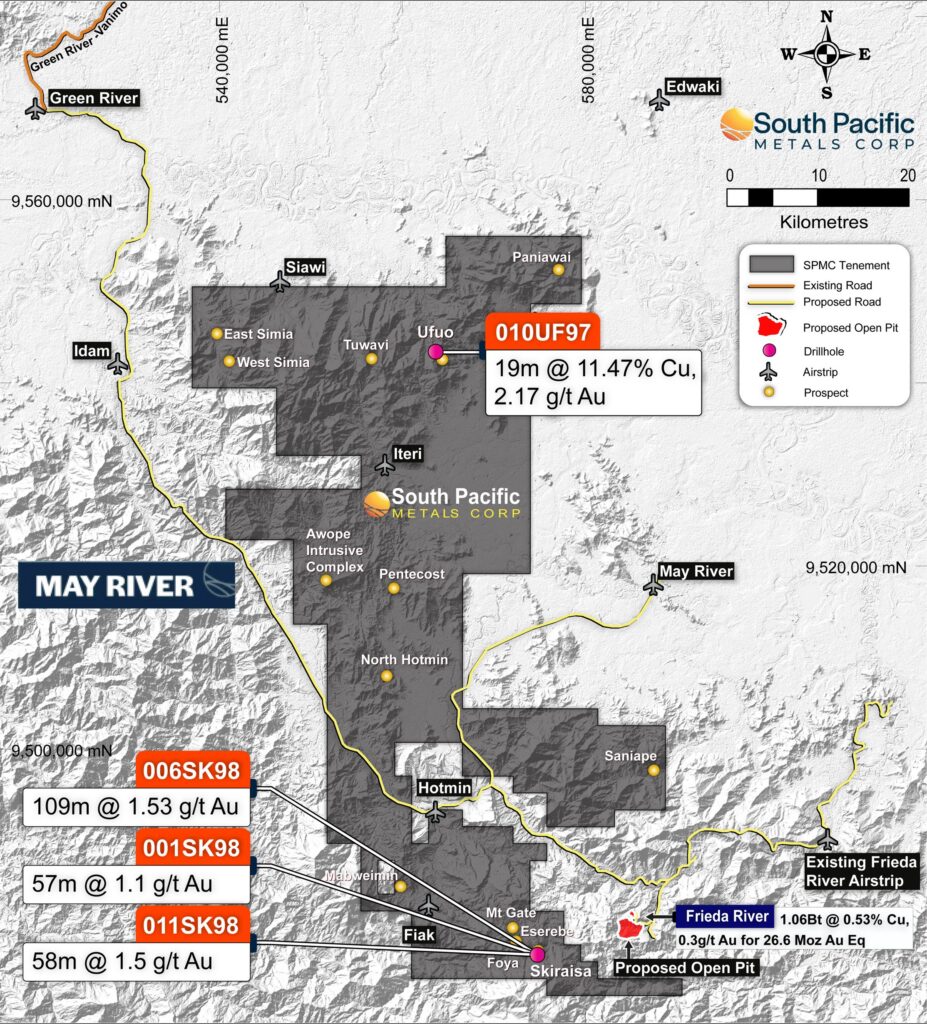
- May River – District-scale system beside Frieda River; high-grade drilling includes 19 m @ 11.47% Cu, 2.17 g/t Au and 109 m @ 1.53 g/t Au.
SPMC common shares are listed on the TSX Venture Exchange (TSX-V: SPMC), the OTCQB Marketplace (OTCQB: SPMEF) and Frankfurt Stock Exchange (FSE: 6J00).
For Further Information
South Pacific Metals Corp.
710–1030 West Georgia Street, Vancouver, BC V6E 2Y3, Canada
Michael Murphy, Executive Chair
+1 (604) 260-0309
Email: info@southpacificmetals.ca
Website: southpacificmetals.ca
Neither the TSX Venture Exchange nor its Regulation Services Provider (as that term is defined in the policies of the TSX Venture Exchange) accepts responsibility for the adequacy or accuracy of this release.
Forward-Looking Statements
This news release contains “forward-looking statements” within the meaning of applicable Canadian securities legislation, including statements regarding the Company’s exploration plans, the timing and scope of field and drilling programmes, the targeting potential of the Ontenu NE, Ontenu Central, Anga, Kili Teke and May River projects, expected stakeholder engagement, and the staging of future work. Forward-looking statements can generally be identified by words such as “believes,” “anticipates,” “expects,” “plans,” “may,” “estimates,” and similar terms. Forward-looking statements are based on current expectations and assumptions and are subject to risks and uncertainties, including risks relating to exploration results, geological interpretation, commodity prices, currency exchange rates, access and permitting, community and stakeholder relations, the political and regulatory environment in Papua New Guinea, and the availability of capital. Readers are cautioned that mineralisation hosted on adjacent or nearby properties (including K92 Mining’s properties) is not necessarily indicative of mineralisation hosted on the Company’s properties. The Company has made assumptions including, without limitation, the success of the Company’s projects, prices for metals remaining as estimated, currency exchange rates remaining as estimated, availability of funds, capital and reclamation estimates, no labour-related disruptions, no unplanned delays or interruptions in scheduled work, and the timely receipt of all necessary permits, licenses and regulatory approvals. Actual results may differ materially. Additional risk factors are identified in the Company’s filings with Canadian securities regulators on SEDAR+ (www.sedarplus.ca). Forward-looking statements are made as of the date of this news release, and the Company assumes no obligation to update or revise them except as required by applicable law.